
The Four Causes of a Custom Object: How Master Workshops & AI Bring Bespoke Architecture Back to the Room
Aristotle asked four questions of every made thing. A spec sheet that answers all four is how a drawing becomes a walnut dining table, a bronze lamp and a glass pendant, made by hand.
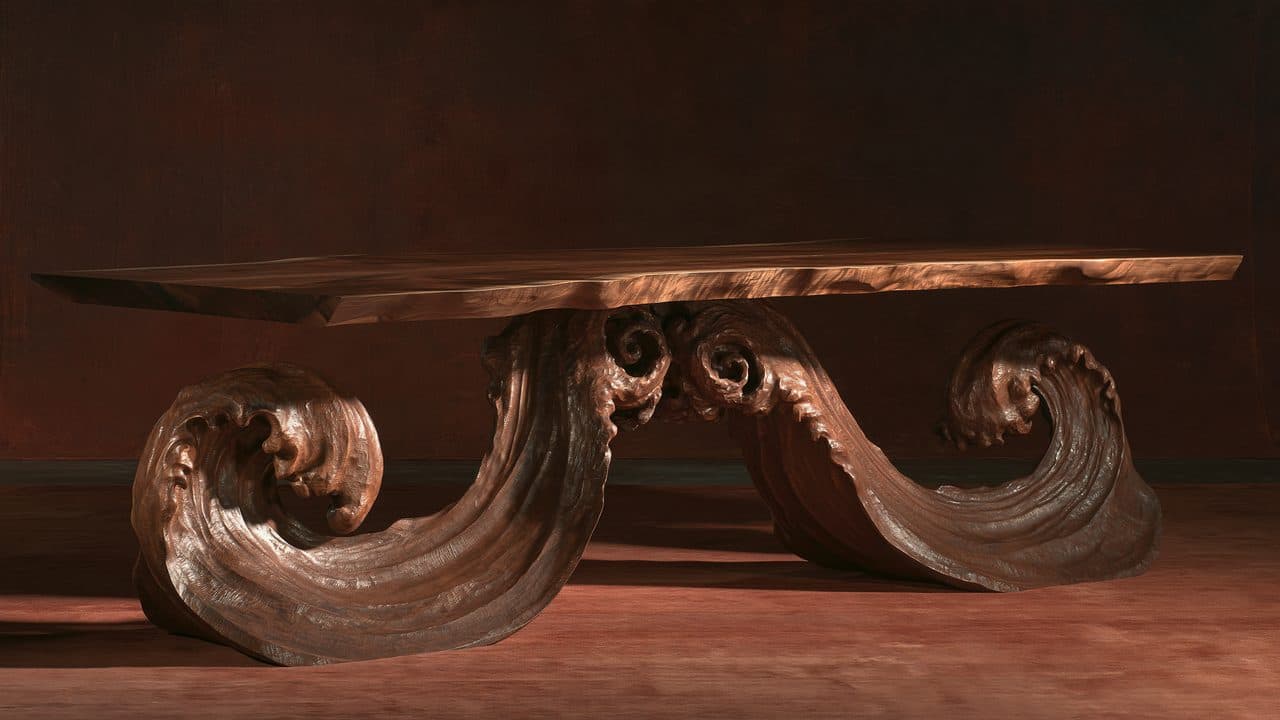
Walk into almost any room finished in the last thirty years and you can name where most of it came from. The sofa came from a catalogue, the table from a showroom, the light from a page of a hundred lights. Each was chosen. Very little of it was made for the room it stands in.
It was not always so. For most of history a room of any ambition was built the other way round: someone imagined the object, and a workshop made it for that wall, that ceiling, that family at that table. Bespoke furniture and lighting were the architecture of the interior. What ended them was not taste. It was the cost of getting from an idea to a maker who could build it, and of the two of them agreeing on what it was.
That second problem is older than the first, and Aristotle had a tool for it.
Four questions for every made thing
In the Physics, Aristotle says we understand a thing only when we can say why it is, and that there are four ways to answer. What is it made of: the material cause. What form and measure does it take: the formal cause. Who or what made it, and how: the efficient cause. And what is it for: the final cause.
Men do not think they know a thing till they have grasped the ‘why’ of it.
Aristotle, Physics II.3, translated by R. P. Hardie and R. K. Gaye
A workshop asked to quote a commission needs exactly those four answers, and a vague brief is one that skips some of them. "A sculptural walnut table" gives a material and a mood. It does not say how thick the top is, how the base is joined, who carves it, or how it gets through a door. So the quote comes back padded for risk, or slowly, or not at all.
Every flagship piece in the Hiram Guild has a public spec sheet written in the four causes, in Aristotle's order. Three of them show how much a complete answer carries.
The Tide Table: wood
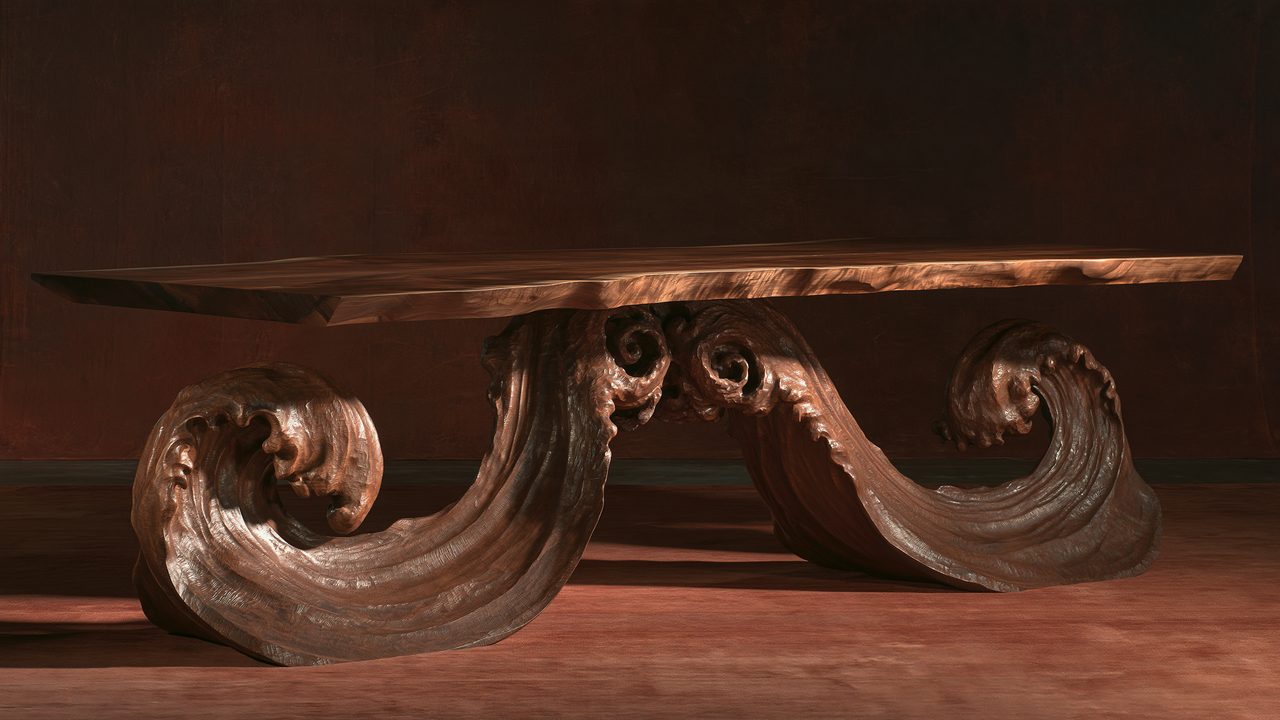
Material: FAS quartersawn black walnut, 8/4 boards for the top and stacked, laminated 12/4 blanks for the base, finished in hardwax oil. Form: 96 × 42 × 30 inches, a top 1¾ inches thick, and two carved wave pedestals about 30 inches across whose crests reach to within 14 inches of the centre line, tied by a steel rail hidden in the top. Maker: a woodcarver with a joiner, roughing out by CNC if they choose and finishing every surface by gouge. Purpose: a dining table for eight that is also sculpture, and that comes apart into three pieces to move.
That last line is the one most briefs leave out, and it changes the joinery: the base bolts on with removable hanger bolts. A carver in the Guild's wood workshops can price that sheet without a phone call.
The Daphne Lamp: metal and light
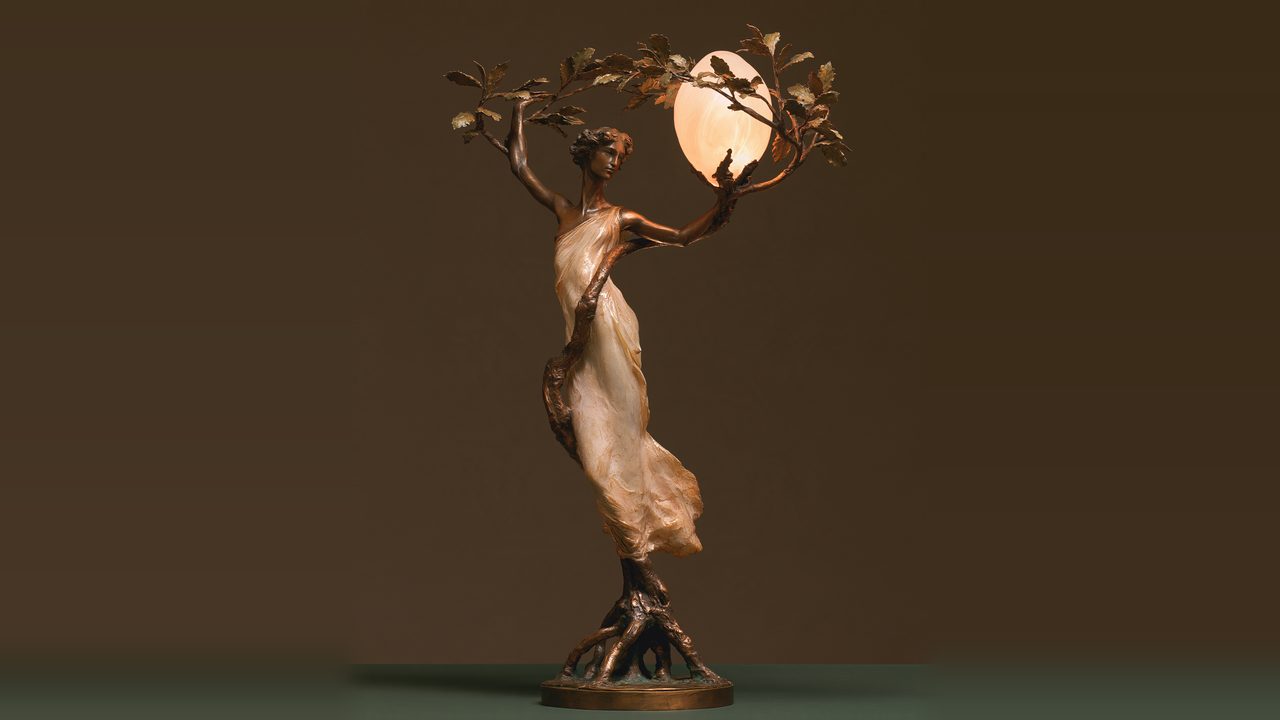
Daphne, fleeing Apollo, became a laurel; the lamp catches her mid-change. Material: silicon bronze with a chestnut patina, waxed, and a hand-blown opal glass bud. Form: 24 inches high and 14 across the branches on a weighted base, with a wire channel cast through the trunk and one branch. Makers: a figurative sculptor and an art foundry for the wax model, the ceramic shell, the casting in three parts, the welding, chasing and patina; a glassblower for the bud; a licensed electrician for the UL-listed wiring. Purpose: a reading lamp, dimmable and warm at 2700K, and a myth in one object.
Four trades meet in one table lamp. The efficient cause is where a custom piece most often fails, because no single shop owns all of it. Naming every hand in advance is what lets the metal and lighting workshops quote their part, and see the rest.
The Pomegranate: glass
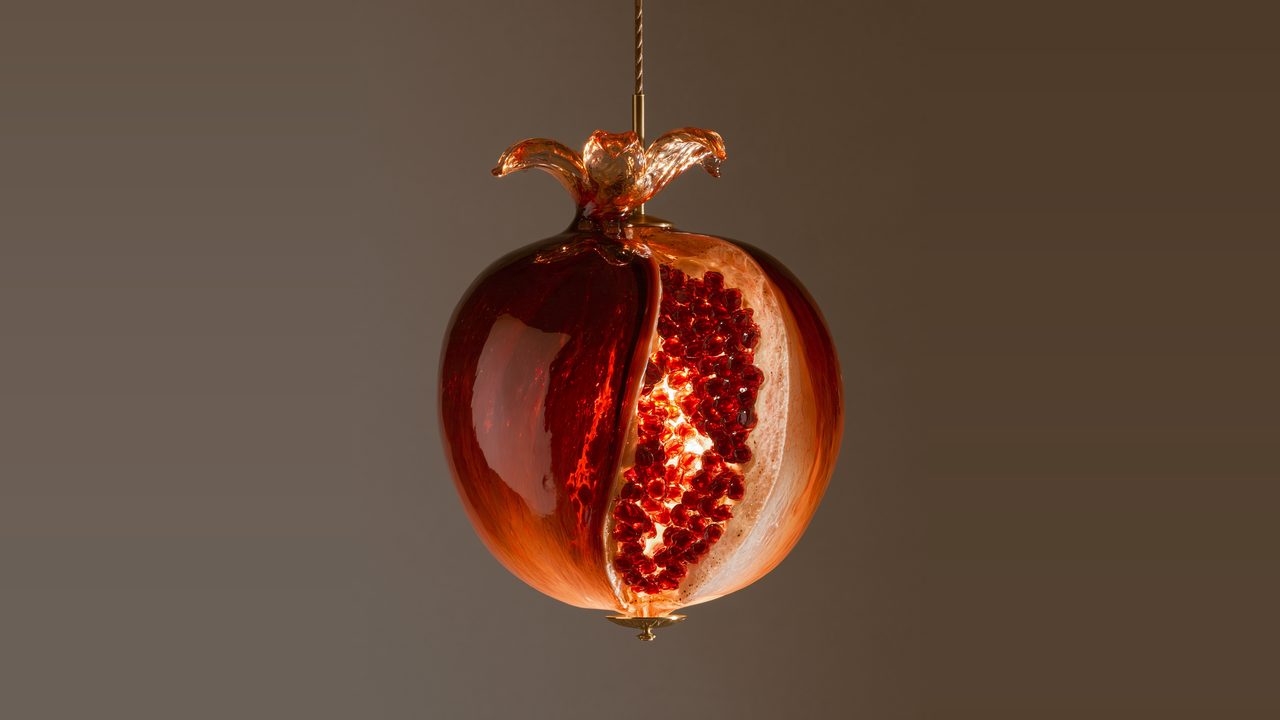
Material: soft soda-lime glass, Murano-compatible: garnet cased over amber for the skin, gold-ruby for the seeds, clear for the inner globe that holds the light, on a brass frame. Form: 16 inches across, split open about 7 inches, with some three hundred seeds of half an inch to three quarters fused onto the inner globe. Makers: a glassblower for the skin, calyx and globe, a flameworker for the seeds, a metalsmith for the canopy and frame. Purpose: a dining pendant, and the pomegranate's old meaning of abundance, which ran through the Renaissance from Florentine silk damasks to the Madonna's hand.
Read the formal cause again: three hundred seeds is a number a flameworker can price by the hour. "Lots of seeds" is not. The glass workshops quote the first kind of sentence.
Where AI belongs, and where it doesn't
Each of these pieces began as an image: an object crossed with a few styles from art history (a dining table × water × the Baroque × Japanese tradition), drawn by an image model in seconds. Dream, Renaissance's design tool, does the same for anyone. That part is new, and it is genuinely useful. A designer can test thirty directions for a client's dining room before lunch.
But a picture answers only the formal cause, and only roughly. So Dream does three more things with it. It photographs the design from nine angles, so a maker sees the back and the underside. It builds a 3D model the designer can turn and place in the room (GLB, USDZ, STL). And it writes a manufacturing brief in the four causes, for a person to correct.
What the model cannot do is the efficient cause. It can name the trades; it cannot carve a wave or gather glass. Every decision that makes the object stand up, light, or last belongs to the workshop that builds it, and the brief is a starting point the maker is expected to change. The machine shortens the distance between an idea and the right bench. The bench does the rest.
Bringing it back to the room
The Hiram Guild lists thousands of American workshops across seven crafts: wood, metal and lighting, stone, ceramics, glass, upholstery and textiles. A commission starts with a 50% deposit that secures the bench and buys the materials; the balance is due when the client signs off photos of the finished piece, before it ships.
- Interior designers can specify a piece for a client, with nine angles, a 3D model and a brief to sign off: Renaissance for the trade.
- Workshops can read any spec sheet and quote it, or claim their Guild profile.
- Anyone can start a piece in Dream.
The four causes are not a method we invented. They are the oldest checklist there is for making something on purpose. Answer all four, and a room can once again be furnished with things made for it.