Portraits · Poets · XII of XIV
Percy Bysshe Shelley
1792–1822 · Poet
Read it in the source →The mind in creation is as a fading coal, which some invisible influence, like an inconstant wind, awakens to transitory brightness.
Poetry is not like reasoning, a power to be exerted according to the determination of the will. A man cannot say, "I will compose poetry." The greatest poet even cannot say it; for the mind in creation is as a fading coal, which some invisible influence, like an inconstant wind, awakens to transitory brightness.
Percy Bysshe Shelley wrote this in A Defence of Poetry in 1821, a year before he drowned off the Italian coast. No one, he argued, can simply decide to compose a poem: inspiration flares and fades like a coal in the wind, and by the time composition begins it is already declining.
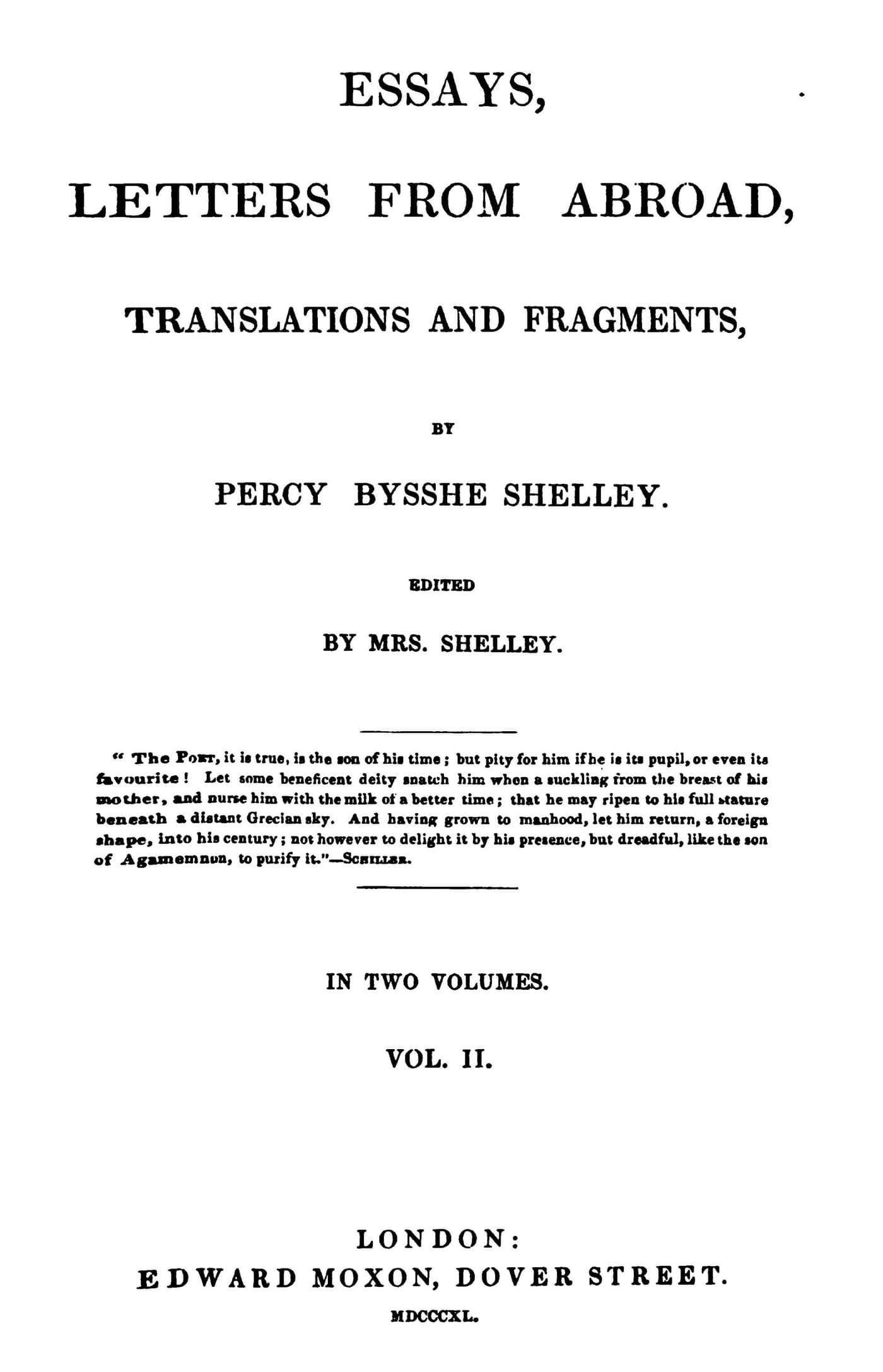
The essay was not published until 1840, when his widow Mary Shelley printed it.
A Defence of Poetry (written 1821, published 1840). Essays, Letters from Abroad, Translations and Fragments, ed. Mrs. [Mary] Shelley (London: Edward Moxon, 1840), vol. 1, pp. 47–48.
The originals