Aristotle · Nicomachean Ethics
Book I, Chapter 1
Chapter 1 · 24 passages · Original translation · Plain English
Main Text by Aristotle
[You can listen and read along]
Listen · Podcast
On the Ultimate Good and Politics
Every art, and every science reduced to a teachable form, and in like manner every action and moral choice, aims, it is thought, at some good: for which reason a common and by no means a bad description of the Chief Good is, “that which all things aim at.”
Every skill, every area of study, and every action or choice we make is aimed at achieving something good. This is why people often describe the ultimate good as "that which everything aims toward."
Now there plainly is a difference in the Ends proposed: for in some cases they are acts of working, and in others certain works or tangible results beyond and beside the acts of working: and where there are certain Ends beyond and beside the actions, the works are in their nature better than the acts of working.
There is a clear difference in what we aim for: sometimes our goal is simply the activity itself, and other times our goal is to produce something as a result of that activity. When we aim to produce something beyond the activity, that product is more valuable than the activity itself.
Again, since actions and arts and sciences are many, the Ends likewise come to be many: of the healing art, for instance, health; of the ship-building art, a vessel; of the military art, victory; and of domestic management, wealth; are respectively the Ends.
Since there are many different activities, crafts, and fields of study, there are also many different goals. For example, the goal of medicine is health, the goal of shipbuilding is to create a ship, the goal of military strategy is victory, and the goal of household management is wealth.



| Art/Science/Activity | End/Goal | Type of End | |
|---|---|---|---|
| 1 | Healing art (Medicine) | Health | Product/Result beyond the activity |
| 2 | Playing music | The act of playing | Activity itself |
| 3 | Ship-building art | A vessel | Product/Result beyond the activity |
| 4 | Dancing | The act of dancing | Activity itself |
| 5 | Military art | Victory | Product/Result beyond the activity |
| 6 | Philosophical contemplation | The act of thinking | Activity itself |
| 7 | Domestic management | Wealth | Product/Result beyond the activity |
| 8 | Seeing | The act of seeing | Activity itself |
And whatever of such actions, arts, or sciences range under some one faculty (as under that of horsemanship the art of making bridles, and all that are connected with the manufacture of horse-furniture in general; this itself again, and every action connected with war, under the military art; and in the same way others under others), in all such, the Ends of the master-arts are more choice-worthy than those ranging under them, because it is with a view to the former that the latter are pursued.
When different activities or skills fall under one main skill (for example, making bridles and other horse equipment falls under horsemanship, and horsemanship itself falls under the military art), the goal of the main skill is always more important than the goals of the smaller skills beneath it. This is because we pursue the smaller skills in order to achieve the goal of the main skill.

Modern Examples
Software Development
Master-art: Building a social media platform
Subordinate arts: UI/UX design, database architecture, cybersecurity protocols, API development
- Why the master-art's end is more choice-worthy: We don't design user interfaces or secure databases for their own sake, but to create a functioning platform that connects people.
Healthcare
Master-art: Patient care and healing
Subordinate arts: Pharmaceutical development, medical imaging technology, surgical instrument manufacturing, lab testing procedures
- The end of medicine (health) is more choice-worthy than the end of any particular diagnostic tool or drug, which exist to serve that greater goal.
Film Production
Master-art: Creating a movie
Subordinate arts: Cinematography, sound design, costume design, set construction, special effects, musical scoring
- We value the lighting technician's work and the composer's score because they contribute to the film's overall artistic vision, not as isolated achievements.
Education
Master-art: Educating students / cultivating minds
Subordinate arts: Curriculum design, educational technology development, textbook publishing, assessment tools
- The apps, textbooks, and testing methods exist for the sake of learning, not vice versa.
Sustainable Energy Infrastructure
Master-art: Providing clean, reliable energy to society
Subordinate arts: Solar panel manufacturing, battery technology, smart grid software, turbine engineering
- Each component technology is pursued for the sake of the larger goal of energy independence and environmental sustainability.
Restaurant/Culinary Arts
Master-art: Creating a dining experience
Subordinate arts: Kitchen equipment design, food sourcing, cooking techniques, service protocols, interior design
- The knife-maker's craft and the sommelier's expertise serve the chef's and restaurateur's vision.
(And in this comparison it makes no difference whether the acts of working are themselves the Ends of the actions, or something further beside them, as is the case in the arts and sciences we have been just speaking of.)
(For this comparison, it doesn't matter whether the goal is the activity itself or something we create through that activity, as we saw in the examples above.)
Since then of all things which may be done there is some one End which we desire for its own sake, and with a view to which we desire everything else;
Since there is one ultimate goal that we want for its own sake, and everything else we want is just a way to reach that goal;
and since we do not choose in all instances with a further End in view (for then men would go on without limit, and so the desire would be unsatisfied and fruitless), this plainly must be the Chief Good, i.e. the best thing of all.
and if we always kept choosing things for the sake of something else, we would go on forever, making our desire pointless and empty. So this ultimate goal must be the Chief Good—in other words, the best thing of all.
Surely then, even with reference to actual life and conduct, the knowledge of it must have great weight; and like archers, with a mark in view, we shall be more likely to hit upon what is right: and if so, we ought to try to describe, in outline at least, what it is and of which of the sciences and faculties it is the End.
So knowing what this ultimate goal is should really matter for how we live our lives. Just like archers shoot better when they can see their target, we'll make better choices if we know what we're aiming for. That's why we should try to figure out what this goal is and which area of study it belongs to.
Now one would naturally suppose it to be the End of that which is most commanding and most inclusive: and to this description, πολιτικὴ[1] plainly answers: for this it is that determines which of the sciences should be in the communities, and which kind individuals are to learn, and what degree of proficiency is to be required.
You would naturally think this ultimate goal belongs to the most important and all-encompassing field of study. That field is politics (πολιτικὴ)[1]. Politics decides which subjects should be taught in society, who should learn them, and how well people need to know them.

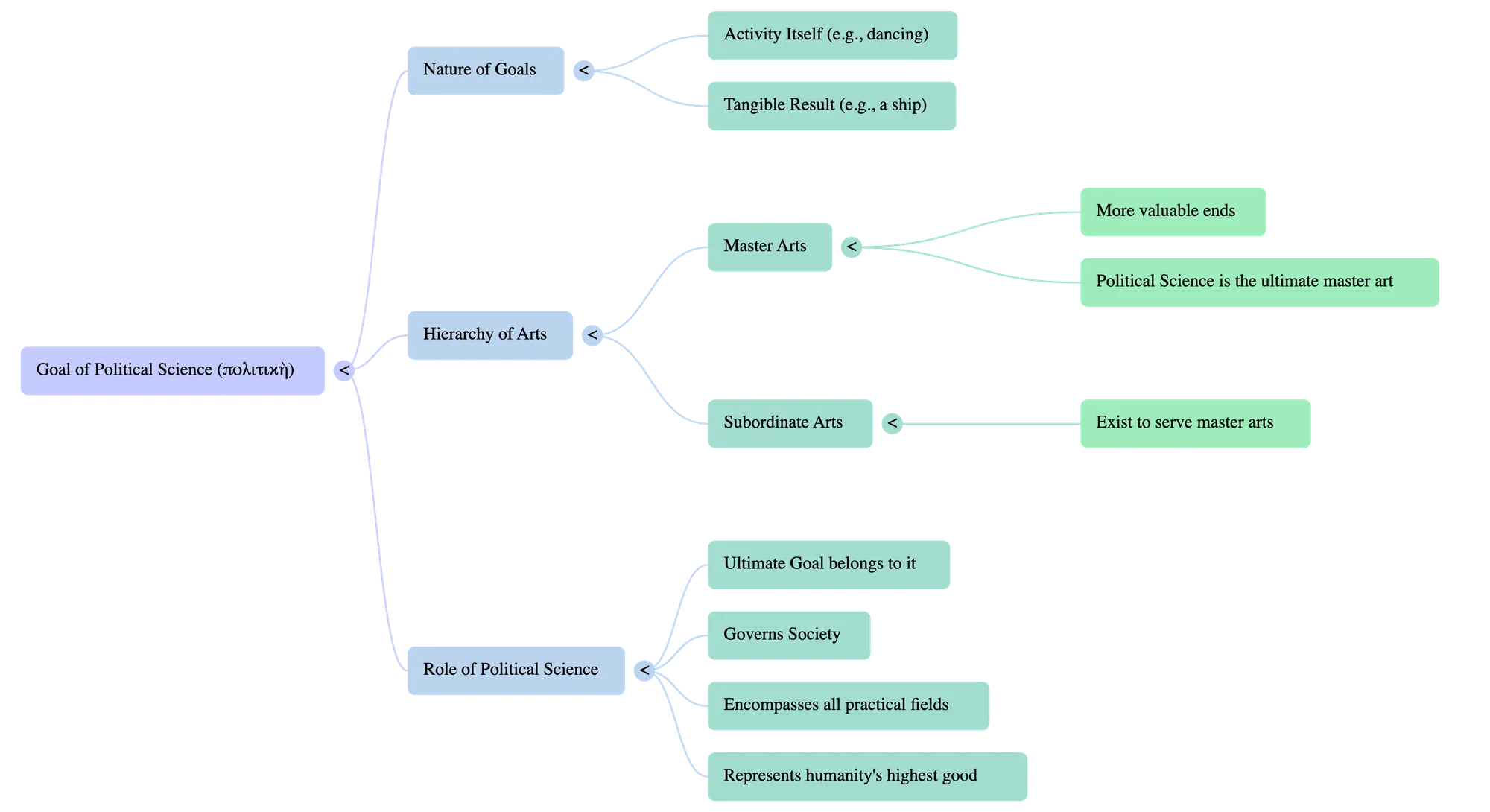
Again; we see also ranging under this the most highly esteemed faculties, such as the art military, and that of domestic management, and Rhetoric.
We can also see that politics includes other highly respected fields, such as military strategy, household management, and the art of persuasive speaking [rhetoric].
Well then, since this uses all the other practical sciences, and moreover lays down rules as to what men are to do, and from what to abstain, the End of this must include the Ends of the rest, and so must be The Good of Man.
So, since politics uses all the other practical fields of study, and also sets the rules for what people should and shouldn't do, its goal must include all the other goals. This means it aims at The Good of humanity.
And grant that this is the same to the individual and to the community, yet surely that of the latter is plainly greater and more perfect to discover and preserve: for to do this even for a single individual were a matter for contentment; but to do it for a whole nation, and for communities generally, were more noble and godlike.
Even if the good is the same for one person and for an entire community, achieving it for the community is clearly more important and worthwhile. It's satisfying to help even one person reach this goal, but to do it for a whole nation or society is nobler and more divine.

Such then are the objects proposed by our treatise, which is of the nature of πολιτικὴ: and I conceive I shall have spoken on them satisfactorily, if they be made as distinctly clear as the nature of the subject-matter will admit: for exactness must not be looked for in all discussions alike, any more than in all works of handicraft.
These are the topics this book will cover, and it's part of political philosophy (πολιτικὴ). I'll consider my explanations successful if I make things as clear as the topic allows. We can't expect the same level of precision in every discussion, just like we can't expect it in every kind of craft or handiwork.
Now the notions of nobleness and justice, with the examination of which πολιτικὴ is concerned, admit of variation and error to such a degree, that they are supposed by some to exist conventionally only, and not in the nature of things: but then, again, the things which are allowed to be goods admit of a similar error, because harm comes to many from them: for before now some have perished through wealth, and others through valour.
The ideas of what is noble and just—which political philosophy (πολιτικὴ) studies—are so debatable and unclear that some people think these concepts are just social conventions, not natural truths. Even things we all agree are good can be problematic in a similar way, since they can actually harm people: some have been destroyed by their wealth, and others by their courage.
We must be content then, in speaking of such things and from such data, to set forth the truth roughly and in outline; in other words, since we are speaking of general matter and from general data, to draw also conclusions merely general.
So when we talk about these topics, we have to accept that we can only give a rough outline of the truth. Since we're discussing general principles and working from general examples, we can only reach general conclusions.
And in the same spirit should each person receive what we say: for the man of education will seek exactness so far in each subject as the nature of the thing admits, it being plainly much the same absurdity to put up with a mathematician who tries to persuade instead of proving, and to demand strict demonstrative reasoning of a Rhetorician.
You should approach what I'm saying with this same understanding: an educated person knows how much precision to expect in each topic based on what that topic allows. It would be silly to accept a mathematician who just tries to convince you instead of proving things with logic. It would be equally silly to demand rigorous logical proofs from someone teaching the art of persuasive speaking.
Now each man judges well what he knows, and of these things he is a good judge: on each particular matter then he is a good judge who has been instructed in it, and in a general way the man of general mental cultivation [2]
People are good judges of things they know about. So someone who has been taught about a specific topic can judge it well. And someone with broad education can judge many things well.

Hence the young man is not a fit student of Moral Philosophy, for he has no experience in the actions of life, while all that is said presupposes and is concerned with these: and in the next place, since he is apt to follow the impulses of his passions, he will hear as though he heard not, and to no profit, the end in view being practice and not mere knowledge.
This is why young people aren't ready to study Moral Philosophy. They haven't lived enough to understand how life really works, and everything we're discussing is based on real-life experience. Also, young people tend to act on their emotions and impulses. So even if they listen to these lessons, they won't really hear them or benefit from them. The goal here is to learn how to live well, not just to know facts.
And I draw no distinction between young in years, and youthful in temper and disposition: the defect to which I allude being no direct result of the time, but of living at the beck and call of passion, and following each object as it rises.[3]
It doesn't matter whether someone is young in age or just acts young—the problem I'm talking about isn't about how old they are. It's about letting emotions control their decisions and chasing after whatever catches their attention.

For to them that are such the knowledge comes to be unprofitable, as to those of imperfect self-control: but, to those who form their desires and act in accordance with reason, to have knowledge on these points must be very profitable.
For people like this, this knowledge won't help them—just like it won't help people who can't control themselves. But for those who shape their desires and actions based on reason, learning about these topics will be very valuable.
Let thus much suffice by way of preface on these three points, the student, the spirit in which our observations should be received, and the object which we propose.
That's enough introduction. I've covered three key points: who should study this subject, how you should approach what I'm saying, and what we're trying to achieve.
End of Text by Aristotle
Bonus Material: Guides & Resources
1Video Overview
2Audio Podcast
Podcast #1
Listen · Podcast
The Chain of Command for Desire: Ancient Philosophys Search fo
Podcast #2
Listen · Podcast
Politics and the Chief Good
3Study Guide: The Good, Ends, and Political Science
Short-Answer Quiz
- How does the text define the "Chief Good" in its opening lines?
- Explain the two distinct types of "Ends" (goals) that an activity or art can have.
- What is the relationship between a "master-art" and a "subordinate art," and why is the end of the master-art considered superior?
- According to the text, why would human desire become "unsatisfied and fruitless" if there were no single, ultimate End?
- What analogy does the author use to illustrate the practical importance of knowing the Chief Good?
- Which science is identified as the "most commanding and most inclusive," and why is it given this title?
- The text provides three distinct meanings for the term πολιτικὴ. Briefly list all three.
- How does the author compare the value of achieving the good for a single individual versus for an entire community or nation?
- Why does the text argue that discussions concerning "nobleness and justice" must be content with setting forth the truth "roughly and in outline"?
- Who does the author claim is an unfit student for Moral Philosophy, and for what two primary reasons?
Answer Key
- The text provides a common description of the Chief Good as "that which all things aim at." It is presented as the ultimate End that is desired for its own sake, with all other things being desired as a means to achieve it.
- The two types of Ends are the activity itself and a tangible result or product that exists beyond the activity. The text states that when an activity produces a result, that result (the "work") is inherently better than the activity (the "act of working").
- A master-art is a broad field, like the military art, that directs and encompasses multiple subordinate arts, such as making bridles. The end of the master-art is considered "more choice-worthy" because the subordinate arts are pursued specifically for the sake of achieving the master-art's goal.
- If there were no single End desired for its own sake, people would always choose things with a view to a further end. This would create an infinite chain ("go on without limit"), rendering the initial desire pointless and ultimately unsatisfying.
- The author compares a person who knows the Chief Good to an archer with a clear mark in view. Just as an archer with a target is more likely to hit it, a person who understands their ultimate goal is more likely to "hit upon what is right" in life and conduct.
- The science of πολιτικὴ (politics) is identified as the most commanding and inclusive. It is given this title because it determines which sciences should exist in a community, who should learn them, and to what degree, and it lays down the rules for human conduct.
- The three meanings of πολιτικὴ are: 1) "The science of Society," its most inclusive definition; 2) "Moral Philosophy," focusing on the moral training of the individual; and 3) "The detail of Civil Government," which was its most common usage.
- The author states that achieving the good for an entire community is "plainly greater and more perfect" than achieving it for just one person. While helping an individual is a "matter for contentment," doing so for a whole nation is described as "more noble and godlike."
- The concepts of nobleness and justice admit of so much "variation and error" that some believe they are mere convention. Because the subject matter is not precise, one can only use general data to draw general conclusions, presenting the truth roughly rather than with the exactness of a science like mathematics.
- A young man is considered an unfit student for Moral Philosophy. This is because he lacks experience in the "actions of life," which the subject is based on, and he is apt to follow his passions, which prevents him from learning for the sake of practice rather than mere knowledge.
Essay Questions
- Analyze the concept of the hierarchy of arts and ends. Using at least three modern examples from the text (e.g., Software Development, Film Production, Medicine), explain how subordinate arts possess instrumental value in service of a master-art that aims at something intrinsically valuable.
- The text claims that πολιτικὴ is the master-art that directs all others toward "The Good of Man." Discuss the three definitions of πολιτικὴ provided and explain how the first and broadest sense, "The science of Society," justifies its role as the most commanding and inclusive of all human faculties.
- Explore the author's argument regarding the appropriate level of precision for different fields of study. Contrast the methodology required for Moral Philosophy with the exactness demanded of a mathematician, and explain why an educated person must adjust their expectations for proof and clarity based on the subject matter.
- The text makes a strong claim about the necessary qualifications for a student of Moral Philosophy. Elaborate on why "experience in the actions of life" and the ability to act "in accordance with reason" are considered essential prerequisites for benefiting from this study.
- Explain the author's argument against an infinite regress of desires. How does the proposition of a "Chief Good," desired for its own sake, solve this problem and give meaning and direction to human action?
Glossary of Key Terms
| Term | Definition from the Source Context | |
|---|---|---|
| 1 | Chief Good | The ultimate End "which all things aim at." It is desired for its own sake, and everything else is desired with a view to it. |
| 2 | End | The goal or purpose of an art, science, action, or choice. An end can either be an "act of working" (the activity itself) or a "work" or "tangible result" beyond the activity. |
| 3 | Master-Art | A commanding and inclusive science or faculty (e.g., military art, governance) that directs and organizes subordinate arts. Its End is considered more choice-worthy. |
| 4 | Subordinate Art | A specific skill or science (e.g., bridle-making, legislative drafting) that ranges under and serves the purpose of a master-art. |
| 5 | Instrumental Value | The quality of being good as a means to a further end. The source implies subordinate arts have instrumental value as they are "pursued for the sake of" the master-art's ends. |
| 6 | Intrinsic Value | The quality of being good or desirable in and of itself, as an end. The text implies master-arts aim at something intrinsically valuable. |
| 7 | πολιτικὴ | A Greek term for which there is no direct English equivalent. The text defines it in three ways: 1) The Science of Society: The most commanding and inclusive field, concerning all aspects of human well-being. 2) Moral Philosophy: The branch of the science of society focused on the moral training of the individual. 3) The detail of Civil Government: The practical management of government, its most common meaning. |
| 8 | The Good of Man | The ultimate End or goal of πολιτικὴ. Because this science uses all other practical sciences, its End is said to include the ends of all the rest. |
The Archer and the Physician
Both books open ethics with a craft. Read the other one.
Maimonides, Eight Chapters · I →